
Hands-On Labs vs Technical Interviews: Test Real Skills

Author
Ewa Piwowarczyk
There's a developer somewhere in Europe - let's call him Marek - who has never failed an interview in his life.
Marek is magnificent on paper. His CV reads like the index of a computer science textbook. Ask him to explain the difference between a mutex and a semaphore and he'll give you a TED talk. Ask him what happens during a TCP handshake and he'll draw you a diagram so beautiful you'll want to frame it.
Marek has only one small, career-long problem: when you actually sit him in front of a terminal and ask him to do the thing he just explained so eloquently, something mysterious happens. The cursor blinks. Marek stares. The cursor blinks again. And somewhere a hiring manager quietly ages three years.
Every recruiter has met a Marek. The tragedy is that most of us meet him after we've already hired him.
The interview theater we all secretly hate
Here's an uncomfortable truth the whole industry agrees on but rarely says out loud: the traditional technical interview is, to a large degree, theater.
We sit a candidate in a room (or a Zoom). We pull our best engineer out of real, paid, productive work to play the role of human polygraph for two hours. The candidate, meanwhile, performs the ancient ritual of "talking confidently about things." Whoever talks the most confidently usually wins.
This is roughly like hiring a chef based on how passionately they can describe an omelette.
And the costs pile up quietly. Your senior developer - the one you pay a small fortune precisely because their time is valuable - spends a meaningful chunk of every week interviewing instead of building. They start to resent it. They start declining interview slots ("sorry, I've got a release"). The recruiter, stuck in the middle, waits days for feedback that arrives as a shrug and the phrase "yeah, he seemed… fine?"
Meanwhile, your best candidate - the quiet one who is genuinely brilliant but freezes when three strangers stare at her - has already accepted an offer somewhere else, because your process took eleven days and theirs took three.
Nobody enjoys this. Not the engineer. Not the recruiter. Not the CEO signing off on a "Senior" who turns out to be a confident junior with excellent slides. And definitely not the candidate.
So why do we keep doing it? Because for a long time, the only alternative to "watch someone talk about code" was "make them solve a LeetCode puzzle that has nothing to do with the actual job and that, by the way, has been posted online with full solutions since 2019."
There had to be a better way to answer the only question that actually matters: can this person do the work?
Enter the lab: a desk, not a quiz
A practical lab is a refreshingly simple idea. Instead of asking the candidate whether they can configure a server, harden a system, fix a vulnerability or debug a broken pipeline - you give them a real machine and say: go on then.
On cp.center, this isn't a metaphor. A lab is a real, live virtual machine that spins up automatically on Azure the moment your candidate opens their assessment. It's not a multiple-choice question dressed up to look practical. It's an actual environment - with a real operating system, real tools, real problems waiting to be solved - and the candidate does the work the way they'd do it on day one of the job.
Want to know if someone can really do incident response? Drop them into a compromised box and watch what they hunt for. Want to know if your DevOps candidate can actually configure things, not just talk about configuring things? Hand them the broken config. Want to see if your "Senior Pentester" deserves the title? Give them a target.
This is the difference between asking a candidate "can you swim?" and tossing them - gently, professionally, with full consent - into the pool.
Marek, bless him, is a magnificent describer of swimming.
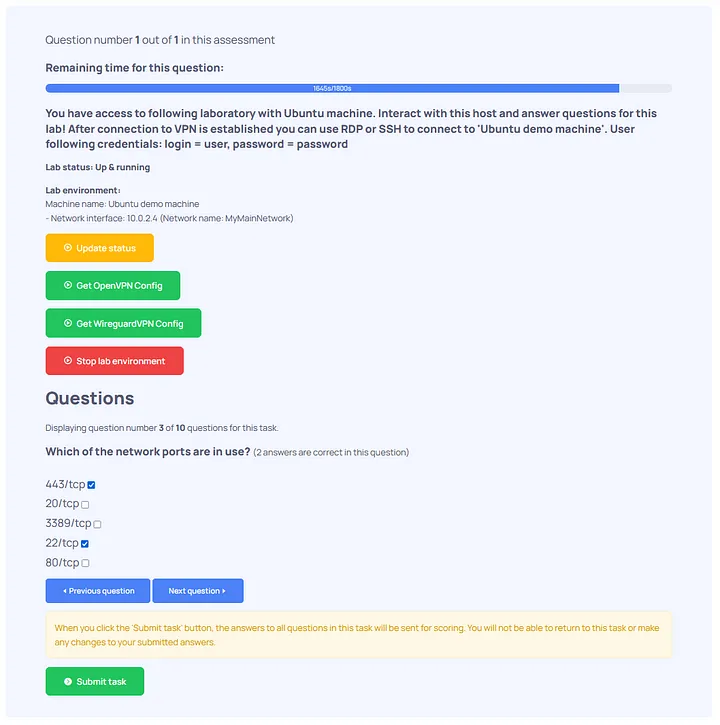
"But who's going to grade all this?" — Nobody. That's the point.
Here's where most recruiters reasonably get nervous. Lovely idea, you're thinking, but I'm not technical. If a candidate spends an hour configuring Kubernetes, who on earth checks whether they did it right? Me? I'll have to drag an engineer in again - and we're right back where we started.
This is the part that tends to make people sit up straight.
The lab grades itself. Automatically. In seconds.
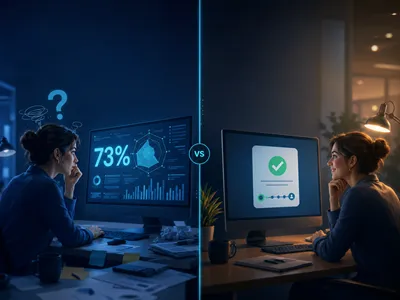
When the candidate finishes, the platform checks the actual state of the machine against what a correct solution looks like - did the service come up, is the vulnerability actually patched, does the code pass the unit tests, is the system genuinely hardened - and produces a verdict. Not a raw, cryptic "73%" that you then have to go interpret. A clear, human-readable answer to the question you actually asked: is this person suitable for the role, or not? Complete with an AI summary of their strengths and weak spots, written in language a non-engineer can act on.
So the recruiter - yes, the one who proudly cannot tell a Kubernetes from a kubernetes - gets to make a confident, evidence-based shortlist decision without booking ninety minutes of a senior engineer's life. And the engineer? The engineer gets to keep building, and only meets the three candidates who genuinely earned the conversation, instead of the thirty who didn't.
Everybody exhales.
How it actually works (the unglamorous, wonderful details)
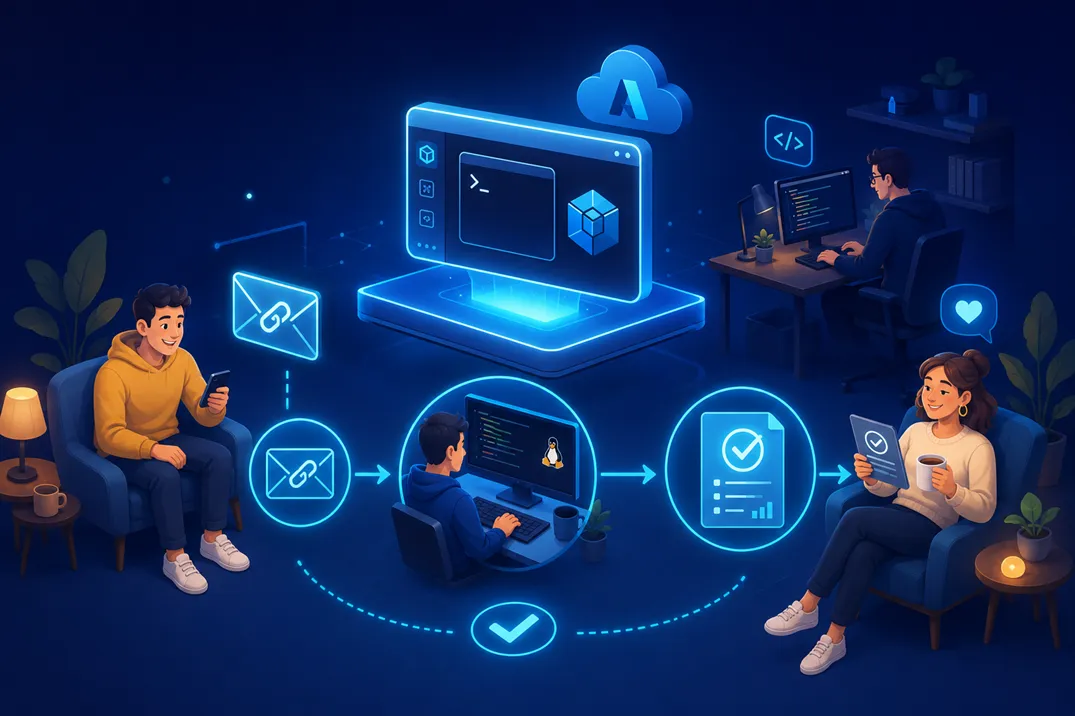
The whole thing is almost suspiciously easy to run, which is rather the point. The flow looks like this:
- Pick what you're actually hiring for. Choose from a big library of ready-made role profiles - across development, cloud, DevOps and the full sprawl of cybersecurity.
- Send one link. The candidate gets a single link. They click. That's the entire onboarding. No account to create, no password to invent, no "please verify your email" purgatory, no fifteen-field GDPR form standing between a busy senior engineer and your assessment. (This matters more than it sounds: the easiest way to lose a great candidate is to make them register for something at 9pm on a Tuesday.) The lab boots up for them on its own.
- They do the work. Real environment, real tasks. And because every candidate gets a freshly randomized set drawn from a vast question bank, you're not handing out the same test that's been screenshotted onto a forum somewhere. The lab runs in an isolated container on the server, copy-paste-to-ChatGPT escape hatches are closed, and timers are tight enough that phoning a friend isn't a viable strategy. The result on your screen is the candidate's own work.
- You read a verdict, not a riddle. Seconds after they finish, you have a report that says, in plain words, whether they can do the job - and a tidy side-by-side view when you want to compare your top few. Decision made today, not next week. Candidate still warm, still interested, still un-poached by your competitor.
That's it. No engineer summoned. No calendar Tetris across three time zones. No "he seemed fine."
Marek deserves a happy ending too
Let's be fair to Marek. The point of all this isn't to humiliate the confident talkers. It's that the world is also full of anti-Mareks - brilliant, quietly competent people who are dreadful at performing competence in a high-pressure room but who, given a real machine and a real problem, are an absolute joy to watch work.
The interview theater rewards the wrong one and overlooks the right one. Labs flip that. They don't care how you describe swimming. They just want to see you swim - and they'll happily watch the quiet genius do twenty laps while Marek is still adjusting his goggles and explaining the physics of buoyancy.
Hire the swimmer. Let Marek keep the TED talk.
Curious what a lab looks like from the candidate's side? cp.center gives you three full tests for free - no credit card, no sales call, no swimming goggles required. Go solve one. It's the fastest way to understand why "can you explain it?" and "can you do it?" are two completely different questions: cp.center.
Related Posts
All posts

Get your three regular assessments for free now!
- All available job profiles included
- Start assessing your candidates' skills right away
- No time restrictions - register now, use your free assessments later
- All available job profiles included
- Start assessing your candidates' skills right away
- No time restrictions - register now, use your free assessments later