
What a Good Technical Assessment Report Should Tell You

Author
Ewa Piwowarczyk
A recruiter I know - let's call her Anna - once described the most frustrating thirty seconds of her week.
A candidate finishes a technical assessment. The platform pings her. She opens the report, and there it is, rendered in a confident shade of blue: 73%. There's a radar chart with seven axes she can't name. There's a bar that's mostly green. There's a percentile. There is, in short, a great deal of information.
And Anna, who is very good at her job and not even slightly ashamed of not being an engineer, stares at it and thinks the only thought that matters:
73% of what? Is that good? Good for which role? What exactly can't this person do? Do I invite them in - or not?
The report doesn't say. So Anna does what the report has quietly forced her to do: she forwards it to a senior engineer, adds "when you get a sec", and waits. Three days later the answer arrives, and it is - I promise you this is real - "yeah, he seems fine?"
Three days. For a shrug. For a candidate who, by the way, accepted another offer on day two.
Here's the uncomfortable thing nobody in the assessment industry likes to say out loud: a report that needs a translator isn't a report. It's raw data wearing a nice chart.
The report is not the test. The report is the product.
We talk endlessly about assessments - the questions, the labs, the anti-cheating, the coverage. All of it matters. But for the person who actually uses the result - the recruiter - none of it exists until it becomes a report. The report is the only part of the entire system they ever touch.
And most reports are written by engineers, for engineers. They are technically immaculate and humanly useless. They give you a number when you needed a decision. They give you a percentile when you needed a verdict. They assume the reader can translate "scored low on idempotent API design" into "do I call this person back," which is a bit like handing someone a blood panel instead of telling them whether they're sick.
So they get forwarded. To an engineer. Who is then pulled out of real, paid, productive work to interpret a report - which is the exact bottleneck the assessment was supposed to remove. The tool didn't save anyone's time. It just moved the queue.
A good report ends that. A good report is not a measurement. It's a decision, handed to you ready to make.
Here are the five things a genuinely good technical assessment report tells a non-technical recruiter - and that most reports, expensively, do not.
1. A go / no-go verdict in plain words - not a percentage to interpret
This is the whole ballgame.
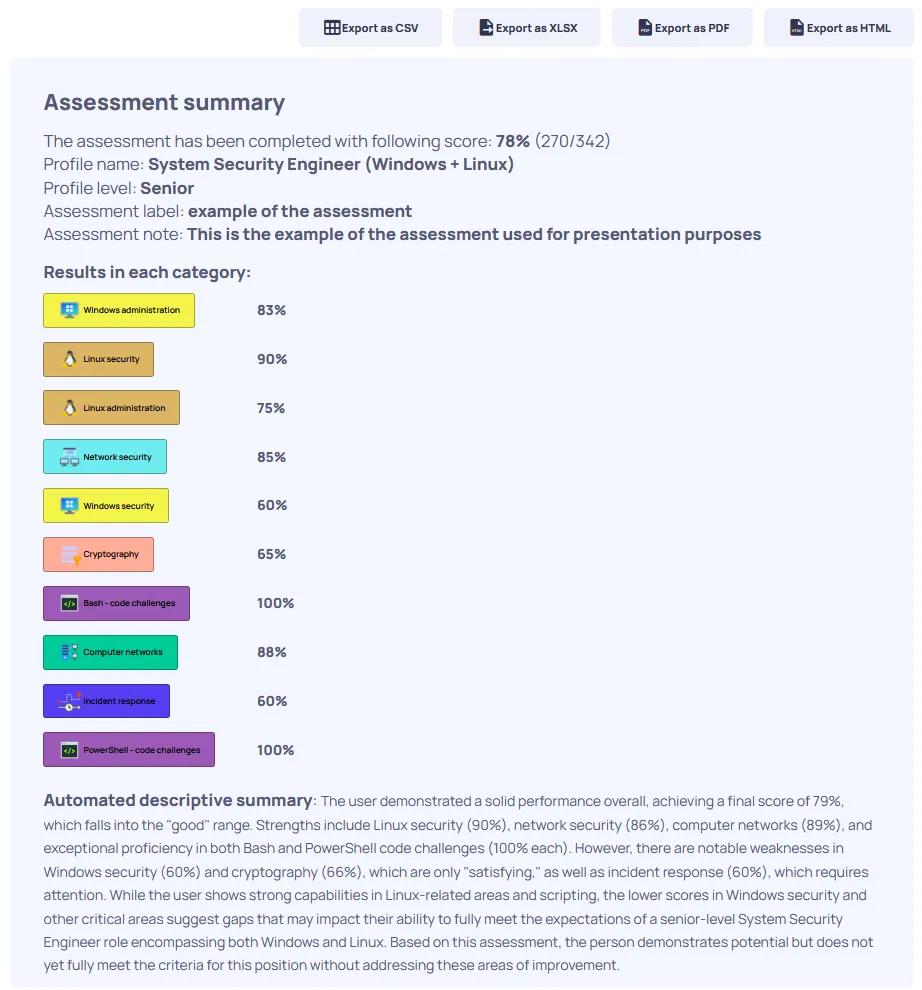
The recruiter is asking exactly one question - do I move this person forward? - and a good report answers that question, in that language, first. Not "73%." Something a human can act on: "Meets the bar for this role at Regular level. Strong overall, with one gap worth probing." Or, just as usefully: "Does not meet the Senior threshold - significant gaps in the core security tasks."
At cp.center the result lands seconds after the candidate finishes, and it leads with a plain-language verdict plus an AI-written summary of strengths and weak spots - in words a non-engineer can read and act on. Not a cryptic 73% you have to go and get decoded. The answer to the question you actually asked, at the top, in a sentence.
A number is something you have to interpret. A verdict is something you can use.
2. The result, anchored to the role you're actually hiring for
"73%" has no meaning until you know 73% of what, measured against whom.
The same score can be excellent for an Entry-level developer and an outright disqualifier for a Senior security engineer. A report that hands you a bare percentage is making you supply the context it should have supplied. A good report already knows what you're hiring for, and tells you how the candidate measures against that - not against some abstract global average.
This is why context isn't a nice-to-have; it's the difference between a score and a judgement. cp.center evaluates against 114 competence profiles across three levels - Entry, Regular, Senior - and 237 topic areas. The report doesn't say "73%." It says "Regular-level back-end developer: meets the bar." The percentage, if you even want it, is a footnote to the verdict - not a riddle in its place.
3. A map of strengths and gaps - so you know what to probe
A good report doesn't end the conversation. It aims it.
Because here's what happens after a "yes": someone still has to interview this person. And the difference between a great technical interview and a painful one is knowing, in advance, exactly where to push. A report that tells you "strong across the board except input validation and error handling" has just turned a ninety-minute interrogation into a focused fifteen-minute conversation about the two things that actually matter.
That's not just nicer. It's the mechanism by which your senior engineers stop interviewing thirty people and start interviewing the three who earned it - and even then, only about the things the report flagged. The report does the wide screening; the human does the deep, narrow follow-up. That's the division of labour that actually saves time, and a report that only gives you a number can't do it.
4. Evidence, not assertion - what the candidate actually did
There's a quiet difference between a report that says a candidate knows something and a report that proves they did it.
When an assessment includes practical work - a live lab, a real machine, a "fix this vulnerability" task - a good report tells you the candidate didn't describe the fix. They shipped it. The service came up. The vulnerability is actually patched. The code passes the tests. The verdict isn't an opinion about the candidate's confidence; it's a fact about the state of a machine.
This is also what makes the rest of the report trustworthy. A beautifully readable verdict is worthless if you don't believe it - and you shouldn't believe a result that a candidate could have pulled off a forum or pasted from a chatbot. At cp.center every candidate gets a freshly randomized set drawn from 280,000+ questions and tasks, runs code in isolated containers on our servers, works against tight per-question timers, and can't copy-paste their way to a friend. So when the report says "this person can do the work," it's describing this person - not the internet's collective memory of the answer.
Readable plus trustworthy is the whole point. Either one alone is a liability.
5. A format that reaches the right person - without you retyping anything
The verdict is clear. Now it has to travel.
The recruiter wants a clean PDF to forward to the hiring manager. The ops analyst wants a CSV or XLSX to line up forty candidates in a spreadsheet. The recruitment platform wants structured JSON to pull the result straight into the ATS, so nobody re-keys a single field. A good report doesn't make you the integration layer - copying numbers out of one tool and into your own template at 7pm.
cp.center exports one result in five formats - PDF, HTML, CSV, XLSX, and JSON over an API - plus a REST endpoint so results land in your ATS automatically. And when you've got a shortlist, a side-by-side view puts your top three next to each other instead of making you open five PDFs and hold the differences in your head. One assessment, every stakeholder served, zero retyping.

"But is it even true?" - readability is worthless without trust
Quick gut-check, because it's the objection every good recruiter raises: a report you can read is useless if you can't believe it.
That's why points 1-3 (readable) and point 4 (trustworthy) are two halves of the same thing. And here's the part I find genuinely persuasive. Our longest-standing client - a firm that recruits specialists for serious, regulated environments - has had a candidate they'd already rejected come back into play, and get hired, after a cp.center report changed their minds. The report didn't just rubber-stamp a decision they'd already made. It corrected one. That only happens when a report is both clear enough to act on and credible enough to overrule a human gut feeling.
A 30-second test for your current reports
Open the last report your current tool gave you, and tick the boxes:
- You had to ask an engineer what the score meant.
- It gave you a percentage but never said "for which role."
- After reading it, you still didn't know what to ask in the interview.
- To send it onward, you copied numbers into your own template.
- You weren't fully sure the work was the candidate's - and not ChatGPT's.
Tick two or more, and here's the situation: you're paying for a tool that measures candidates but won't make a decision. The decision - the expensive, time-consuming, bottleneck-shaped part - it quietly left on your desk.
Back to Anna
Imagine Anna's week with a better report.
The candidate finishes. Seconds later she opens a verdict that reads, in plain English: "Regular-level back-end developer - meets the bar. Strong on data modelling and API design. One gap: input validation. Worth a focused question in the interview." She forwards the PDF to the hiring manager. She books the interview for tomorrow, with one thing to dig into. No engineer summoned. No three-day wait. No "seems fine?". And the candidate is still warm, still interested, still un-poached.
That's the difference between a number and a decision. A good report doesn't ask you to become technical. It does the technical part for you, and hands you back the one thing you came for: a confident next move.
cp.center works whether you're hiring three people a year or three thousand. And you don't have to take my word for what its reports look like - run three full assessments for free at cp.center. No credit card, no demo call, no thirty-minute discovery with a sales person. Generate a real report, read it yourself, and see whether "73% of what?" ever has to be your problem again.
Related Posts
All posts


Get your three regular assessments for free now!
- All available job profiles included
- Start assessing your candidates' skills right away
- No time restrictions - register now, use your free assessments later
- All available job profiles included
- Start assessing your candidates' skills right away
- No time restrictions - register now, use your free assessments later