
Transforming Corporate Training with Modern HR Tech

Author
Krystian Piwowarczyk
Corporate training is under pressure as skills evolve faster than traditional programs can adapt. Employees expect accessible, relevant learning, while leaders demand proof that training improves performance and retention.
This article explains how modern HR technology addresses these challenges by connecting HR systems, learning platforms, analytics, and AI into a cohesive ecosystem. It explores why legacy models fail at scale, how LMS platforms remain foundational, how virtual and AI-powered tools work in practice, and how data transforms learning from a cost center into a measurable business capability.
Introduction and Foundations of Modern HR Learning Architecture
Imagine a software engineer opening a mandatory training portal on their first day and being greeted by a two-hour slide deck recorded three years ago, explaining tools the team no longer uses. That quiet moment of frustration captures a much bigger problem across corporate learning today. Employees are moving faster than training programs can keep up, and HR teams are under pressure to bridge the gap.
For decades, corporate training relied on classroom sessions, scheduled workshops, and standardized materials delivered a few times a year. That model worked when roles were stable, technology cycles were slow, and teams sat in the same building. Managers could plan training calendars months in advance, instructors reused the same decks, and success was measured by attendance sheets and completion certificates.
Today’s environment is unforgiving to that approach. Digital transformation compresses skill lifecycles, AI reshapes job responsibilities, and global teams operate across time zones. Employees expect learning to be as accessible as the tools they use every day, while executives expect evidence that training improves performance, productivity, and retention. HR leaders find themselves caught between rising expectations and systems that were never designed to deliver continuous, measurable development.
To understand how HR technology closes this gap, it helps to define the core components clearly. Most modern learning architectures rely on four interacting layers. The first is the HRIS, such as Workday HCM or SAP SuccessFactors Employee Central, which stores authoritative data on roles, job families, locations, and reporting structures. The second is the learning delivery layer, typically an LMS like Moodle Workplace or Docebo, responsible for enrollment, content access, assessment, and certification. The third layer is the experience and personalization layer, often implemented with learning experience platforms (LXPs) like Degreed or Viva Learning, which aggregate content and apply AI-driven recommendations. The fourth layer is the analytics and integration layer, using tools such as Azure Data Factory, Power BI, or Tableau to connect learning data to business performance systems.
Without explicit alignment between these layers, organizations accumulate disconnected tools that frustrate learners and obscure results. A clear definition early prevents common failures, such as selecting an AI recommendation engine without reliable skills data or deploying analytics dashboards that cannot access LMS event logs.
This article explores how modern HR technology changes corporate training from a series of isolated events into a connected learning ecosystem. You will see how traditional models break down at scale, why learning management systems still matter, how virtual and AI-powered tools work at an implementation level, and how data and integration turn learning into a business capability rather than a cost center.

The Shift from Traditional Training to Digital Learning Ecosystems
Why does classroom-based training feel increasingly ineffective as organizations grow? The answer usually reveals itself when scale enters the equation. Coordinating facilitators, booking rooms, flying employees in, and keeping content consistent becomes financially and operationally unsustainable. A three-day onboarding workshop delivered in five regional offices often results in five different interpretations of company culture and processes.
At scale, inconsistency turns into operational risk. One regional trainer updates slides to reflect a policy change, while another continues using last quarter’s materials. Without centralized version control, HR teams cannot guarantee everyone received the same information. Digital ecosystems solve this by standardizing content delivery and enforcing a single source of truth through centralized repositories.
Another pressure point comes from skill obsolescence. Technology, marketing, data analysis, and leadership skills decay rapidly. A one-time certification course does not keep a cloud engineer current when Amazon Web Services updates services monthly. Modern learning ecosystems rely on skills taxonomies and competency frameworks stored in HR platforms. Tools like Degreed or Cornerstone Skills Graph maintain structured inventories that map roles to required skills and continuously update proficiency expectations.
Remote and hybrid work accelerated this transition. When teams spread across locations, informal learning disappears. New hires cannot overhear conversations or shadow colleagues. Organizations responded by shifting onboarding and manager training into digital formats accessible on demand. Virtual cohorts replaced classrooms, and recorded sessions allowed employees in different time zones to learn without delay.
In practical terms, a learning ecosystem combines several systems around the learner. A core LMS delivers and tracks training. Content libraries such as LinkedIn Learning or Pluralsight provide up-to-date material. Collaboration tools like Microsoft Teams host discussions. Analytics platforms aggregate learning and performance data. HR teams increasingly design these components to work together rather than expecting a single product to satisfy every need.
Learning Management Systems as the Backbone of Modern Training
When organizations begin modernizing learning, a common question emerges: is an LMS still relevant? Despite newer tools and platforms, the LMS remains the backbone of corporate training because it provides governance, structure, and compliance at scale.
A modern LMS such as Moodle Workplace 4.3, SAP SuccessFactors Learning, or Docebo aligns several core functions. These include course creation, automated user enrollment, assessments, certifications, and reporting. Content interoperability standards matter here. SCORM 1.2 and xAPI ensure courses created in tools like Articulate 360 or Adobe Captivate work reliably across systems and generate consistent data.
A practical example is mandatory onboarding and safety training. Using an LMS, HR assigns role-based learning paths on day one. Completion and assessment results are stored in learner transcripts, and compliance reports can be exported during audits. This standardization reduces operational risk across regulated industries such as healthcare or manufacturing.
Modern LMS platforms differ significantly from legacy systems installed on internal servers. SaaS delivery allows automatic updates and global access through browsers or mobile apps. Employees can complete modules on smartphones before their official start date. APIs enable integration with HRIS platforms like Workday or BambooHR, syncing job roles and triggering training assignments automatically.
However, LMS platforms have limitations. They excel at delivering structured courses but struggle with personalization, social learning, and real-time engagement. Most offer static catalog experiences that feel transactional. This gap explains why organizations layer additional tools around the LMS rather than replacing it entirely.
Virtual Training Platforms for Engagement in Remote and Hybrid Teams
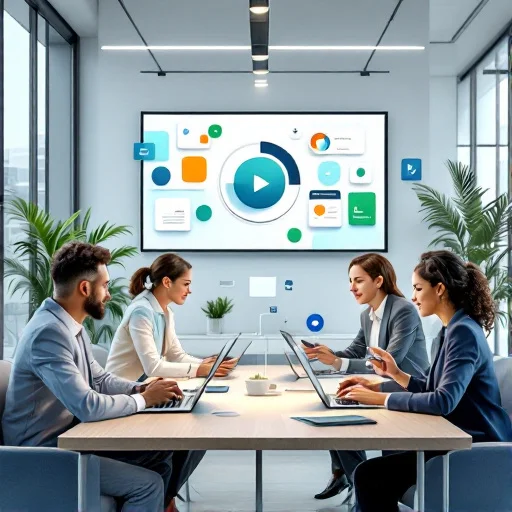
How do you keep learners engaged when participants join from home offices across four time zones? Virtual training platforms address this challenge by recreating interaction that traditional e-learning lacks.
Beyond basic video conferencing, effective implementations require deliberate configuration. In Zoom Workplace, for example, enabling breakout room pre-assignments and attention tracking requires administrator configuration in account settings. Facilitators often pair Zoom with Miro or Microsoft Whiteboard, embedding shared boards directly into Teams meetings so artifacts persist after the session. This persistence gives managers evidence of participation rather than relying on attendance alone.
These solutions fall into several categories. Live virtual classrooms such as Zoom Workplace or Adobe Connect provide video streaming, breakout rooms, and recording. Platforms like Microsoft Teams integrate chat, polling, and whiteboards. Simulation tools overlay interactive scenarios for experiential learning.
Engagement depends on intentional design. Virtual leadership workshops that rely on lecture-style delivery see rapid drop-off. Successful programs use structured interaction. A typical session might follow a numbered flow:
- Send short pre-work videos hosted on the LMS, tracked via xAPI events.
- Open the live session with real-time polling using Mentimeter, exporting results as CSV.
- Break participants into small groups of four to six for discussion, auto-timed to ten minutes.
- Use shared whiteboards with predefined templates to capture insights.
- Close with a facilitated debrief and a post-session assignment completed in the LMS.
Simulations add depth. Customer service teams practice responses using branching scenarios where decisions trigger different outcomes. Safety training uses incident simulations allowing learners to practice risk assessment without real-world consequences. Tools such as Strivr use VR headsets like Meta Quest 2 with 1832×1920 resolution per eye, reducing motion sickness while delivering realistic environments.
Blended learning models combine synchronous and asynchronous elements. Employees watch five- to seven-minute explainer videos, then join live practice sessions focused on application. Organizations report up to 30 percent higher retention when simulations or practice sessions follow content consumption within 72 hours, according to internal benchmarks published by Strivr.
AI-Powered Personalized Learning Paths
Why do two employees in the same role need different training? AI-powered learning systems answer that question by analyzing data rather than assuming uniform needs.
AI identifies skill gaps by processing multiple inputs. Job architecture data defines expected competencies. Performance reviews highlight strengths and weaknesses. Assessments and learning behavior provide evidence of proficiency. Platforms such as Cornerstone Xplor or LinkedIn Learning Hub use machine learning models to infer skill levels based on this data.
At an implementation level, this process relies on structured data pipelines. Skills are often stored as normalized entities with unique IDs. An LMS emits xAPI statements like the following when an assessment is completed:
{"actor":{"mbox":"mailto:jane.doe@company.com"},"verb":{"id":"http://adlnet.gov/expapi/verbs/passed"},"object":{"id":"urn:course:secure-coding-101"},"result":{"score":{"scaled":0.92}}}
These statements feed a learning record store (LRS) such as Learning Locker. AI models consume aggregated records, mapping course outcomes to skills like “OWASP Top 10 awareness.” Recommendation engines then assign confidence scores that decay over time if no reinforcement activity occurs.
Once gaps are identified, recommendation engines personalize content. An employee moving into a sales leadership role receives targeted modules on coaching and forecasting, not generic management courses. In LinkedIn Learning Hub, administrators can weight recommendations by role relevance (for example, 0.5), recency (0.3), and peer consumption (0.2), tuning outputs to business priorities.
AI-driven coaching extends personalization beyond content. Chatbots embedded in tools like Microsoft Viva Learning send reminders, suggest microlearning, and prompt practice. A typical implementation uses Azure OpenAI with prompt constraints limiting responses to approved content sources, reducing hallucination risk. Managers might receive weekly nudges encouraging a feedback conversation, reinforcing formal training through action.
These systems require oversight. Bias and transparency risks emerge when data reflects historical inequities or algorithms are opaque. HR teams mitigate risks by auditing recommendation outputs quarterly, comparing distribution across demographics, and retaining manual overrides for critical development decisions.

Measuring Learning Impact with Data and Analytics
How do you know training is working? Completion rates provide activity metrics but reveal little about impact. Modern learning analytics shift focus from attendance to outcomes.
Effective measurement tracks progression from participation to proficiency using defined metrics. Common learning metrics include time to proficiency, assessment improvement delta, and skill half-life, which estimates how quickly skills decay without reinforcement. Business-aligned metrics vary by function. Sales teams track ramp-up time and quota attainment. Engineering teams track deployment error rates or vulnerability density after secure coding training.
Connecting systems requires deliberate data modeling. Many organizations extract LMS data nightly using APIs, landing it in a cloud data warehouse such as Snowflake. A simple SQL aggregation might join completions to performance data:
SELECT e.employee_id, AVG(p.close_rate) AS avg_close_rate FROM lms_completions c JOIN sales_performance p ON c.employee_id = p.employee_id JOIN employees e ON e.employee_id = c.employee_id WHERE c.course_id = 'product-training-2024' GROUP BY e.employee_id;
Learning leaders then visualize results using Power BI. DAX measures calculate correlations, while filters allow executives to view outcomes by region or role. Dashboards move beyond static reporting by enabling drill-down into cohorts with low performance, informing targeted interventions.
Beyond correlation, some organizations apply controlled experiments. A/B testing assigns half a sales cohort to a new microlearning program while the control group follows the standard curriculum. Differences in deal velocity over 60 days provide stronger evidence of impact than anecdotal feedback.
Dashboards enable adjustment. HR leaders spot low engagement early and redesign content. Programs evolve continuously rather than waiting for annual reviews.
Integration, Governance, and Change Management
Even the best technology fails without adoption. Integration, security, and change management determine long-term success.
Integration connects learning to the employee lifecycle. APIs synchronize LMS platforms with HRIS and performance systems. Single sign-on using SAML 2.0 removes friction. When a role changes in Workday, new learning assignments trigger automatically. Modern employee training processes within an enterprise-class organization can be elevated to new levels of efficiency through integration with platforms such as our CP Center. Simple Web API integration and support for external identity providers (Entra ID, Okta, and Google Workspace) make this step incredibly easy.
Security and privacy matter. Learning records contain personal data and performance indicators. Role-based access control, data encryption at rest, and compliance with GDPR or HIPAA protect trust. HR teams document governance policies defining who can access analytics and how long data is retained.
Adoption requires deliberate change management. Successful rollouts use internal champions, phased deployments, and visible leadership support. Employees need clear communication on how learning supports career growth, not just compliance.

Conclusion
Corporate training has crossed a threshold where incremental fixes no longer work. Modern HR technology transforms learning into a continuous, data-driven ecosystem aligned with business needs.
- Audit your current learning stack and identify gaps beyond the LMS.
- Select tools with clear integration and analytics capabilities.
- Design learning experiences around skills, not courses.
The organizations that thrive treat learning as infrastructure. Start by mapping your challenges, aligning stakeholders, and building a roadmap that connects technology, culture, and performance.
Related Posts
All posts

Get your three regular assessments for free now!
- All available job profiles included
- Start assessing your candidates' skills right away
- No time restrictions - register now, use your free assessments later
- All available job profiles included
- Start assessing your candidates' skills right away
- No time restrictions - register now, use your free assessments later