
4 Myths About CV Formatting That Cost Agencies a Full Salary

Author
Ewa Piwowarczyk
It usually starts the same way.
Coffee, a Zoom call, a recruitment agency owner with that particular kind of confidence that only comes from owning a business that has survived two recessions. We're somewhere around minute fifteen when I ask the question that always ends the small talk.
"How long does it actually take your consultants to reformat one CV into a client template?"
There is a brief pause. The kind of pause that tells you the question has never been asked out loud.
"Oh, that's fast. We're very efficient."
I love this moment. I love it because I know what's coming next.
I know it because at cp.center we sat with a real stopwatch, in a real agency, on a real Friday afternoon. The numbers we got back were so uncomfortable I checked them three times.
What follows are four myths I keep hearing — from owners, recruiters, account managers, occasionally from the person who makes the office coffee - and what happens when you put a clock to each one.
Myth one: "Our consultants format CVs quickly"
Picture Mark. Mark is a real consultant in a real agency. It's Friday, 4:47 PM. There is a candidate CV sitting in his inbox — a senior cloud architect, fifteen years of experience, six certifications, and a list of side projects long enough to fold into a small novella.
The client wants the CV in their template. The template has a section for "Project highlights" but only three lines per project. Mark now has to decide which of the candidate's nine projects to immortalize and which to quietly murder.
Then it gets worse. The template requires certifications in a specific order. The dates need to read "MM/YYYY" not "MM.YYYY". The photo has to be 4 cm by 5 cm. There must be no photo. (The CV is going to a German client. There must be no photo. He missed that the first time. He starts over.)
By the time the CV is ready, Mark has been at it for fifty-two minutes. He has not sent an email. He has not called a candidate. He has not done any of the things that, when you look at his job description, actually justify his salary.
Bullhorn's 2024 industry survey of 1,500+ recruitment firms puts the average at 35-60 minutes per CV. For senior or specialist roles - cybersecurity, cloud, ML - it routinely climbs past 90.
What this costs you, in one sentence: Across a five-person agency, this single task quietly eats the equivalent of one to one-and-a-half full-time salaries every year - money you pay for work the client never sees and you never bill for.
Myth two: "We use a generic AI tool, so it's basically automated"
I get it. Everyone has tried it. ChatGPT, Claude, one of the parsers from the trade fair last spring. They all do something magical in the demo.
Then you actually use them.
Aptitude Research ran 200 CVs through four leading generic AI tools last year, against three different client templates. Roughly one in four fields ended up in the wrong place or invented out of thin air. Certifications came back in random order — large language models treat dates like vague suggestions. "AWS" became "Amazon Web Services" became "Amazon cloud" became, in one memorable case, "Amazon cloudkitchen."
The dirty secret of every AI demo is the part that happens after the screen recording stops: the senior recruiter who quietly opens the output, sighs, and spends twenty minutes fixing it. That step is invisible in the vendor pitch and very visible on your payroll.
What this costs you, in one sentence: Generic AI saves you about a third of the time — and then a senior recruiter, who is your most expensive person on the team, spends twenty minutes per CV un-hallucinating it.
Myth three: "It only takes time. It doesn't cost real money."
This one is my favorite, because it is so charmingly wrong.
A senior IT recruitment consultant costs around 45,000 EUR a year in Poland, around 80,000 in Western Europe. They spend between half and three-quarters of their working week on reformatting documents. Multiply, divide, blink twice — and you arrive at the kind of number that ruins a CEO's Tuesday morning.
I have watched two agency owners do this math live on a video call. The first one went quiet for a long moment and then said, in the voice of someone who has just understood something irreversible: "We're paying senior people to do data entry."
The second one laughed and asked if we could continue the conversation next week.
LinkedIn's 2024 SMB Recruitment Report puts it more politely: mid-sized IT recruitment agencies running below 20% gross margin can typically attribute six to nine percentage points of that gap to manual document operations. Translated into the language people actually use in meetings: fix the formatting problem and you may have just doubled your profit margin.
What this costs you, in one sentence: Somewhere between half and the full salary of one consultant — per consultant, per year — is going into a task that produces zero revenue; in a five-person team, that is the size of the hire you keep saying you can't afford.
Myth four: "There isn't really an alternative."
I hear this one often, and I understand why. Most assessment vendors don't know what a recruitment agency actually does all day. They build features for HR directors at banks. The consultant at 4:47 PM on Friday is somebody else's problem.
So we built it ourselves.
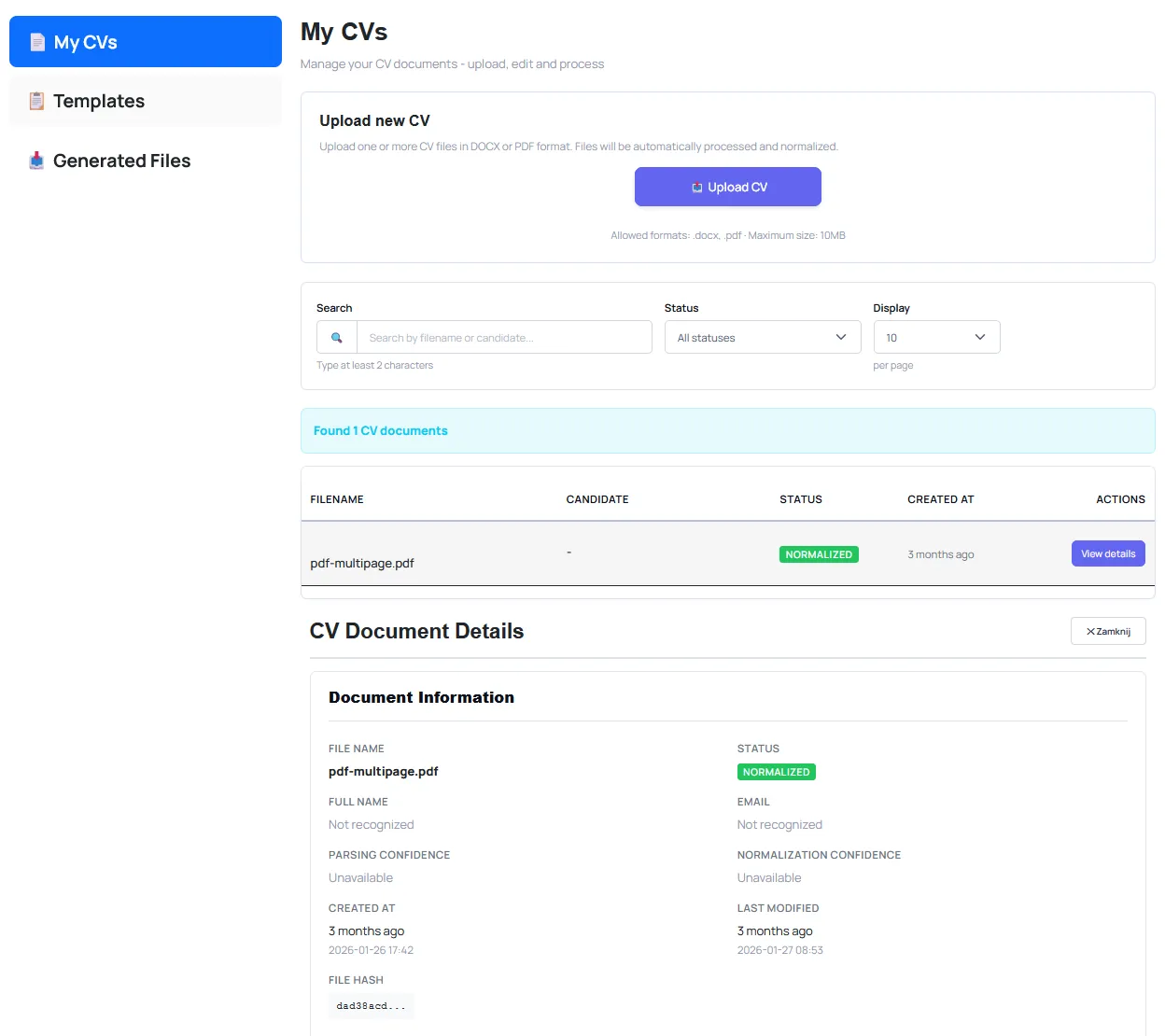
cp.center has a CV Processor inside the platform on the Medium and Large plans. The consultant uploads a candidate's CV, picks the client template, and the formatted version comes back in under three minutes. The mapping is AI-driven, but trained specifically on IT and cybersecurity CVs - meaning the system actually understands that CISSP and OSCP are certifications, not lifestyle choices. It understands that "Senior Backend Engineer" and "Sr. Software Engineer (Backend)" are the same human. It understands that "AWS" is not a city.
What this costs you (or, rather, saves you), in one sentence: Roughly one and a half FTEs of recovered work in a five-person team - savings that, in our clients' experience, pay back the entire cp.center subscription inside the first quarter.
The uncomfortable part
If your agency lives on putting a strong shortlist in front of the client faster than your competitors, and your consultants are still hand-formatting CVs — or, worse, hand-fixing the output of a generic AI - you are not running a sales operation. You are running a very expensive document-formatting operation that occasionally happens to sell people.
That used to be acceptable. It is becoming less so. NIS2 is forcing every regulated client to hire more specialist cybersecurity people. The global cybersecurity workforce gap is sitting at 4.8 million unfilled roles, according to (ISC)². The agencies that win in 2026 are the ones that can put together a credible shortlist before their competitors have finished opening Word.
One last thought
Every industry has its comfortable myths — the small lies we tell ourselves so the calendar doesn't look quite so brutal. The four above are recruitment's. They survive only as long as nobody reaches for a stopwatch.
So the next time you're tempted to say "we're fast enough", try it on one CV. Just one. The number you get back will tell you everything you need to know.
Related Posts
All posts


Get your three regular assessments for free now!
- All available job profiles included
- Start assessing your candidates' skills right away
- No time restrictions - register now, use your free assessments later
- All available job profiles included
- Start assessing your candidates' skills right away
- No time restrictions - register now, use your free assessments later